Tuesday, February 06, 2007

Worms, Worms, and More Worms

In our continuing study of the animal kingdom we have been studying three phyla of worms: Nematoda, Platyhelminthes, and Annelida. The Annelids include the gardener's best friend - the earthworm. I picked these nightcrawlers up at the local convenience store which carries live bait. Some of the students were a little grossed out by working with live worms.


The students began their studies of the earthworm by elliciting nervous system responses. In a dissecting tray the students laid dry and wet paper towels and placed the worms in the middle, covered them with a piece of cardboard and waited five minutes. The worms of course prefer a wet environment, and therefore moved to the wet paper towel side of the tray. Then with the tray covered completely with wet towels the students covered half of the tray with the cardboard and shined a flashlight on the worms. Worms like it dark so they beat a hasty retreat to the side of the tray that was covered by the cardboard.


Lastly, we set up a couple of "wormeries." We layered soil, sand, dead leaves, and some vegetable scraps (potato and apple peelings) in a two liter plastic bottle. Then we introduced 3-4 worms to each bottle. You can see the worms tunneling through this bottle (They are the pinkish layer right above the sandy layer). In order to provide the worms with the environment they prefer we have dark paper sleeves around the bottles to block the bright sunlight, and we keep the soil moistened.
To wrap it all up we have studied earthworm anatomy and conducted dissections. Many students were anxious about the dissections, but admit when it was all over it wasn't so bad.


Thursday, January 11, 2007

New Unit - Animal Kingdom

Today, we introduced a new unit of study in class, the Animal Kingdom. At each lab station I placed samples of preserved animals, models, or skeletons of the various phylum (annelids, mammals, fish, amphebians, cnairdians, porifora, birds, arthropods and reptiles for example). The students went from station to station trying to name the group of animals, and to determine if the group were invertebrate or vertebrate animals. This was a sort of a K-W-L activity to see what the students knew about animals. We did not define what an invertebrate or a vertebrate was as this is a seventh grade class, and we really wanted to see what knowledge base they possess. The kids were definetely involved in this activity and exhibited high levels of interest. We currently have a pair of ringneck doves and several rats in the classroom which the students love to observe, care for, and interact with.

Wednesday, January 10, 2007

Baking Bread - A real world application

It is important for our students to understand why we study the curriculum that we do, and where will it apply in their everyday lives, therefore, as a follow up to our lesson and lab on yeast respiration, we made bread. I pointed out that for centuries we humans have been taking advantage of the process of yeast respiration for our own benefit. Yeast are used in baking, cheese and yogurt production, and in fermenting wine and beer. The emphasis in talking about the process of bread baking was on the requirements for yeast growth (food source, warmth, darkness, and moisture) and how the recipe fullfills these. I also stressed that the bread rises because of the carbon dioxide which is being released as the yeast cells respire. In a previous lab, the students had studied what yeast need to live by "proofing" yeast. They had set up a beaker with yeast and water (the control), and a second beaker with yeast, water and sugar (the experimental sample). They then made a wet mount slide of each sample, staining the yeast in order to see them and count them. The samples were then left overnight in a warm, dark place. The following day the students again prepared wet mount slides of each sample and discovered that sugar caused an increase in the number of yeast cells.

Tuesday, January 09, 2007

Studying Respiration in Yeast

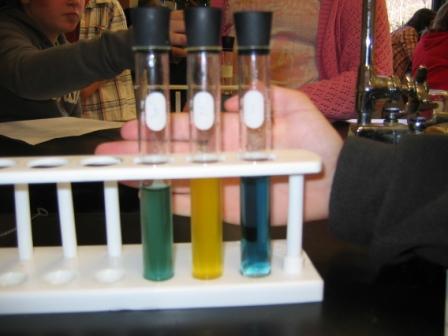
In order to study respiration in yeast we set up an experiment using Bromothymol Blue (an indicator which is sensitive to the pH changes that result when carbon dioxide is dissolved in it), sugar, live yeast cells, and dead yeast cells (yeast were boiled). The students set up three test tubes with 15mL Bromothymol Blue solution and 2 grams of sugar. The first test tube served as a control containing only the Bromothymol Blue solution and sugar. The second tube had live yeast cells added to it, and the third had dead yeast cells added. The samples were then placed in a warm, dark room to incubate over night.


This lab group had an excellent result. From left to right the dead yeast tube, the live yeast tube and the control tube. Some lab groups had tubes that exhibited contamination in the dead yeast tube. Several groups had forgotten to clean their test tubes prior to beginning the lab. Lesson learned, never assume that your glassware is clean even if it looks clean. Of course we are not working under sterile conditions and some contamination is to be expected.


Monday, January 08, 2007

Edible Fungi Models

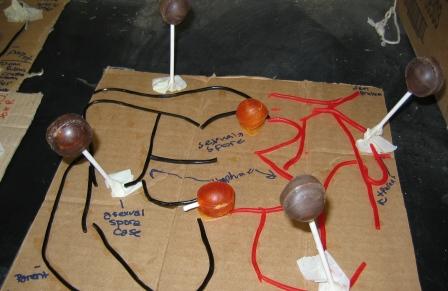
We made edible fungi models in class last Friday. The cardboard base represents a food source (tree branch, fruit, or piece of bread), the red and black licorice represent the hyphae, the tootsie pops standing are asexual spore cases, and the lollipop tops (orange in this model) represent sexual spore cases where +parent and -parent have met. The students had a blast making the models, and eating the extra modeling materials. If you can't get hold of shoe string licorice you may use two different colored yarns or ribbons.

Friday, January 05, 2007

Lichens


Lichens are a symbiotic relationship between fungi and either algae or photosynthetic bacteria (cyanobacteria). Yesterday and today we have been observing lichens in the classroom. For some students it has been hard for them to understand the concept that lichens are composed of two different organisms. One source of difficulty has been in preparing wet mount slides of crushed lichens. It is very easy to observe the algae, but harder to see the fungi hyphae. Any suggestions would be helpful.

Wednesday, January 03, 2007

International Space Station Viewing Opportunities

At school this morning the principal announced that in our area the International Space Station was scheduled to pass directly overhead and the sighting was expected to last up to 5 minutes. You can visit NASA to get information for sightings in your area. The station is best viewed at dawn or dusk when the sun is reflected off it. We took the opportunity to refresh the kids knowledge of how to use a compass in order to locate the station in the sky. Luckily, we had a compass for each student to use. Several students signed up to borrow a compass to use at home tonight. This was also a time to discuss NASA's future plans for space exploration and the role that the space station plays in endeavor.

Tuesday, January 02, 2007

Bread Mold Lab

In the grade 7 Life Science classroom I am currently doing my student teaching internship in, the students are studying mold and fungus. Prior to leaving for Winter Vacation, the students innoculated homemade bread with spores from a moldy orange, sealed the bread in ziplock bags, and placed the bags in their lab drawers. Today, they took out their samples to view the results. First, the students observed the mold using the dissecting microscope. Second, they prepared wet mount slides to better view the hyphae and spores using the compound microscope. We had some great results. One student decided to try lifting the mold off the bread using scotch tape. She had an excellent result! Good thinking!

Thursday, December 21, 2006

Do you know where your water comes from?


Recently, my cub scout den was working on their Engineering Webelo Activity Badge and we made a visit to our town's water department. (This is a photo of the collage we generated about water after our visit and given to the Water Department as a thank you gift for taking the time to meet with us.) I'm not sure what the boys got out of the experience, but I sure learned a lot. Here in New England, the majority of people get their water out of the ground via wells (the same is true for our town). Once the water is pumped up, the pH levels must be adjusted, and then chlorinated. It was fascinating to see how the whole system works. We learned that to work in the Water Department you need to be knowledgeable with mechanics (machinery does break down from time to time), chemistry (the handling and fine balancing of chemicals), geology, computers (the whole system is monitored by computers), and law (a myriad of state and federal laws and regulations governing the use and "production" of water). Today, we take for granted that when we turn on the faucet something will come out and that it will be safe to drink. It certainly is a lesson for all of us to know the behind the scenes process that make our lives so comfortable. (Hint: watch the Discovery Channel's Dirty Jobs show sometime.) Maybe our next field trip should be to the Waste Water Treatment Facility - what goes in must come out.

Wednesday, December 20, 2006

Science Teachers - Free Movie Offer

The producers of An Inconvenient Truth have made 50,000 copies of this documentary on Global Warming available to teachers for free!! Beginning December 18, 2006 until January 18, 2007, these DVDs are available on a first come, first serve basis. Visit http://www.participate.net/ to register for your copy. You will need to provide the 9-digit Tax ID number of the school where you teach. Delivery will take 6-8 weeks. Also at this website you will find companion curriculum guides which you can download.

Thursday, December 14, 2006

Project WET-The Incredible Journey Water Cycle Game


This fall I had the opportunity to attend a teacher workshop sponsored by Projects WET, WILD and Learning Tree held at the Beaver Brook Association located in Hollis, NH. My fellow participants and I enjoyed a fantastic day conducting and learning how to teach environmental science in the perfect outdoor setting.
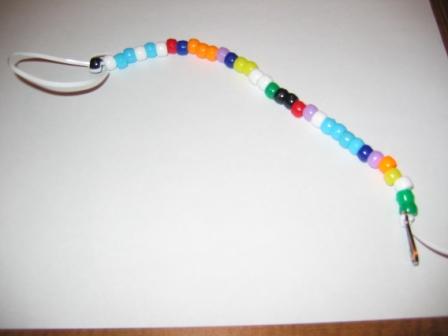
Recently, I used one of the workshop activities called "The Incredible Journey," in the classroom. The fourth graders I was working with had just begun a unit on the water cycle. First, we generated a list of where we can find water. Then I introduced the "Incredible Journey" activity and sent them off on their own water journey. Pictured here is their "journey journal." At each station they placed a colored bead on their lanyard to record where they had been. After 25 minutes of journeying we stopped to discuss where their journey had taken them. In this example, the journey of this water molecule began (the right side of the picture) in a plant (green bead), which then evaporated to the atmosphere through the process of transpiration, condensed into a cloud (white), snowed onto a glacier (yellow), melted into ground water (orange), flowed into a lake (purple), which flowed into a river (dark blue), which flowed into the ocean (light blue), where it stayed for a while (now why would that be?), evaporated into the atmosphere and became a cloud again (white), rained into a lake (purple), was drunk by an animal (red), which urinated (the kids kind of thought that was gross), then seeped into the soil (black), which was absorbed by the roots of a plant (green), which was lost through transpiration to the atmosphere (white), which is where this story began but which will continue and continue and continue which of course is the whole point!!! (Sorry for the run on sentence.) As a follow up activity, the students were asked to imagine that they were a water droplet and to write a descriptive tale of their journey based on their beaded record. Needless to say, the kids had a blast with this activity.

Wednesday, December 13, 2006

Audubon's 107th Christmas Bird Count 12/14-1/5

Beginning tomorrow, December 14th the Audubon Society begins its annual Christmas Bird Count. Visit www.audubon.org/bird/cbc/index.html to learn more about this event and how you might be able to participate. What a great way to expose students to the concept of observation and how this data is used by scientists. You might consider setting up a feeder or two around the school to study the winter habits of birds in your area!!

Tuesday, November 07, 2006

Why Do Leaves Change Color in the Fall?

An essential question in the study of leaves is: Why do they change color in the Fall? This is a great way to start a lesson on photosynthesis and the role that chlorophyll plays in the process. Chlorophyll is the green pigment which captures the sun's energy through a complex series of electron transfers in proteins embedded in the thylakoids of the plant cells' chloroplasts. Chlorophyll absorbs the red/yellow and blue/violet wavelengths of visible light and reflects the green wavelengths, hence its green color to the human eye.

In the fall, the cooler temperatures and shorter amounts of sunlight signal the trees that winter's harsh conditions are approaching. The cells at the base of the leaves' stems begin to die. This prevents water which is necessary for photosynthesis from reaching the leaves. As a result, the chlorophyll in the leaves begins to break down and the yellow and orange carotenoid pigments which were present during the entire summer growing season now appear. The deep red color in leaves comes from anthocyanin pigments which are formed when there are cooler temperatures and photosynthesis slows.

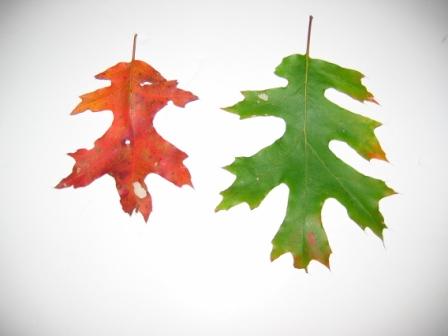
You can see these pigments for yourself by using paper chromatography. Simply gather some fallen leaves, crush them in a glass and mix with either ethyl alcohol or acetone. Attach a strip of coffee filter, paper towel, or chromatography paper to a pencil so that the end of the paper touches the surface of the liquid. The paper/filter will absorb the liquid, and the pigments will travel up with smaller sized molecules traveling the farthest. This process may take up to an hour. Take the strips out and let them dry on clean paper towels. You can see here in this photo the pigments found in two Red Oak tree leaves. Note the green band of chlorophyll still present in the green leaf and none in the red leaf.

Monday, October 09, 2006

Dawn Dishwashing Liquid Helps the Environment

While clipping coupons from the Sunday paper, I came across an ad for Dawn dishwashing soap and their new campaign to raise the awareness of how Dawn is used to help clean wildlife that have been contaminated by oil. Visit http://www.dawnsaveswildlife.com for more information. There is a list of things that students can do to help the wildlife in the environment such as: properly disposing of motor or cooking oils, recycling plastic bags, proper handling of fishing lines and lures, and cutting up of "six pack" can rings.

While at the Dawn site, I found a link to the International Bird Rescue Research Center (IBRRC). The IBRRC has an emergency response team who travel to areas to help rescue and rehabilitate birds contaminated by oil. I was amazed by the before and after photos of a brown pelican. When we are teaching about ecosystems, we should take the time to discuss the impact that humans have on the environment. This issue could also make a great debate topic for older students: how does our transportation and mishandling of oil products affect the environment and what should we do about it?

Monday, October 02, 2006

National Earth Science Week - October 8-14

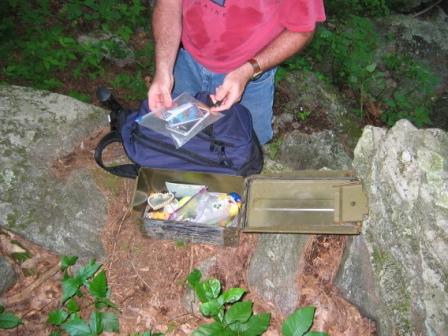
National Earth Science Week sponsored by the American Geologic Institute, kicks off in Washington, D.C. this October 8th with the celebration of International EarthCache Day. EarthCaching is an extension of the popular pastime of Geocaching. Geocaching is a mix of hiking, treasure hunting, and high tech. Cachers use a Global Positioning System (GPS) to find hidden caches at coordinates posted on www.geocaching.com. These photos show my family out caching this summer. Often caches are stored in old ammo boxes or "Tupperware" style containers. The cache includes a log book and trinkets to trade.


This year's theme for Earth Science week is "Be a Citizen Scientist." The annual event was established to help encourage stewardship of the Earth. There are some wonderful classroom activities based on the National Science Education Standards found at http://www.earthsciweek.org/forteachers/classroomactivities.html. Learn more about the American Geological Institute at www.agiweb.org. Another great site to visit is www.earthscienceworld.org, check out their Virtual Oil Well Game.
Even the Girl Scouts are getting into Earth Science, EarthCaching, and Geocaching with their Hi Tech Hide & Seek Interest Patch for girls 11-17.

Tuesday, September 26, 2006

What does a seed need to sprout?

Ask students what they think a seed needs to sprout and you may get a variety of responses. In the February 2006 edition of The American Biology Teacher, researchers interviewed K-8 students, asking them to identify plants (interview items included: grass, trees, mushrooms, ferns, bread mold, telephone pole, walking stick insect, seeds, bushes, flowers, and a Venus flytrap) and items needed for plants to grow (sun, lightbulb, water, cereal, bee, plant food, worm, air, oxygen, carbon dioxide, sandwich, and potting soil). Many students classified flowers as plants but not trees, stating that trees form their own group. Most students, regardless of age stated that plants needed sun, water, air, and soil for growth. They were less certain of whether or not plants needed oxygen or carbon dioxide to grow.

"Inquiry with Seeds: To Meet the Science Education Standards" by Krantz and Barrow, in the same issue, focused on pre-service teachers and their experiences in a semester long course in learning to teach science through inquiry. The pre-service teachers developed a lesson plan to study seed sprouting requirements.

Currently, I am enrolled in a graduate course focusing on teaching science through inquiry. My classmates and I are also studying the requirements for seed sprouting. These photos show my samples for germinating seeds without soil and controlling the variable of light. By using the clear plastic cups, students can observe the seed's activity as it sprouts. They also have the advantage of seeing the root structures, something you cannot observe when seeds are planted in soil.

Wednesday, August 23, 2006

Bird Migration - Flyways

While hiking the Riverside Trail at the Montshire Museum of Science, we came along this sign which explains bird migration. The route 91 corridor, from the mouth of the Connecticut River (in the Long Island Sound) to the Canadian border, plays an important role in New England bird migration. This exhibit is aimed at educating the public in the importance of migratory birds (and insects, i.e. the Monarch butterfly) in our environment and the need to protect the environment along these bird flyways. Migratory birds and insects need three distinct environments in which to survive: their winter home, their summer home, and safe "rest stops" along the path from one home to the other. Urban development and mowing along the sides of highways has decreased the number of safe stopping areas, and has limited food resources.

You can visit the Nutty Birdwatcher for more information about birds and migration. This site has maps of North American Bird Flyways, bird identifications, habitat information, feeding suggestions, and a list of further links.

Tuesday, August 22, 2006

Learning While on Vacation

Recently while touring through Vermont for a family vacation, we made a stop at the Montshire Science Museum in Norwich. The entire family agrees that this museum was worth the stop. Inside you will find many hands-on learning activities in the following disciplines: Light and Vision;Sound; Air and Weather; Anatomy; Astromony; Environment; Live Animals; Math, Mechanics and Motion; and Water and Flow. Outside the museum the fun and learning continues. In the Science Park, you will experience what happens when science meets a water park. Plan on getting wet, you definitely need to bring the right clothes in order to fully experience this exhibit. The museum is located on 100 acres of land bordered by the Connecticut River. They have several well maintained hiking trails for you to explore.

I highly recommend taking advantage of museums like this to expose kids to science and to the fun of learning. Learning doesn't only take place in the classroom.
Hiking the River Trail (Above)


(Left) Aerial View from the top floor of the museum building overlooking the The Science Park- where science and water fun meet!

Wednesday, August 02, 2006

Crickets are Nature's Thermometer

With the current heat wave, I have noticed the nighttime cricket chirps more. Why? Remember that old wives tale about counting the cricket chirps to determine the outside temperature? I did. With a little searching for related internet links, I learned that the snowy tree cricket is responsible for the chirping that we hear. According to several sites, the simple formula to determine temperature in degrees Fahrenheit, is to count chirps for 15 seconds and add 39. Or count for 13 seconds and add 40. A more complicated formula is to count the chirps per minute, subtract 40, divide by 4 and then add 50 [(chirps/min-40)/4 + 50]. Visit Dartmouth Chemistry for an even more advanced mathematical explanation of this natural phenomenon, known as the Arrhenius equation. The equation is a function of temperature and can also be used to describe the rate of an ant's walk or the flashing pattern of fireflies.

Tuesday, June 27, 2006

FREE BOOKS!!! July 4th - August 4th

Summer's here and it's time to catch up on your reading. Project Gutenberg is sponsoring the World eBook Fair beginning July 4th and running through August 4th and will be offered the same time next year. Over 300,000 titles will be offered, of those 95% are in the public domain (no longer copyright protected) and the other 5% have been donated by their copyright holders for this event. The books can be downloaded and read on almost any computer and some cellphones and PDAs. The idea behind this project is to give books away, to be copied and shared with others. The sponsors hope to encourage knowledge and battle illiteracy. Gregory Newby of Project Gutenberg, was quoted in the Boston Globe ("Free chapter added to saga of e-books" by David Mehegan) as saying, "It breaks my heart to go into Barnes & Noble and find Jane Austen for sale in a trade format. Where does that money go? It's close to profiteering. No author is getting any money for it. I feel sorry for schools, where kids are now reading Canterbury Tales or Huckleberry Finn, and the schools are spending millions of dollars from their budgets to buy the books. We're giving the stuff away for free."

Bring your PDA or laptop with you on summer vacation and enjoy a good book. You can learn more about Project Gutenberg by visiting their site at www.gutenberg.org.